FSIPL's Taste Radar 2026: Understanding the 5 Emotional Shifts Defining Indian Food Trends in 2026
If there’s one thing we’ve learnt from watching Indian menus evolve over the last few years, it’s this: consumers are no longer interested in choosing sides.
They don’t want to decide between indulgent or healthy, fast or crafted, premium or affordable. They want all of it, sometimes on the same menu, sometimes in the same product, and often in the same bite.
This shift isn’t accidental.
Indian consumers today are more exposed to global food formats than ever before, yet more rooted in regional identity at the same time. Iced matchas and millet porridges coexist. Korean spice profiles sit comfortably next to coastal Indian sour notes. That confidence is new, and it’s defining how menus are built.
But recognising the shift is only half the equation. Acting on it is where brands either scale or stall.
As Ajay J Mariwala, Managing Director at FSIPL, puts it:
“At FSIPL, our role is to help partners move from intent to action—without compromising on quality, safety, or cost discipline. We do that by combining market signals with strong R&D translation, dependable manufacturing, and formats that fit real kitchens and real service conditions.”
This is the lens behind Taste Radar 2026 from Food Service India. It isn’t a prediction of what might happen someday. It’s a working view of what is already scaling quietly, consistently, and across formats.
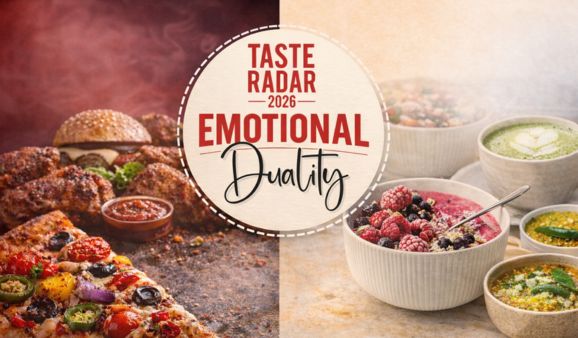
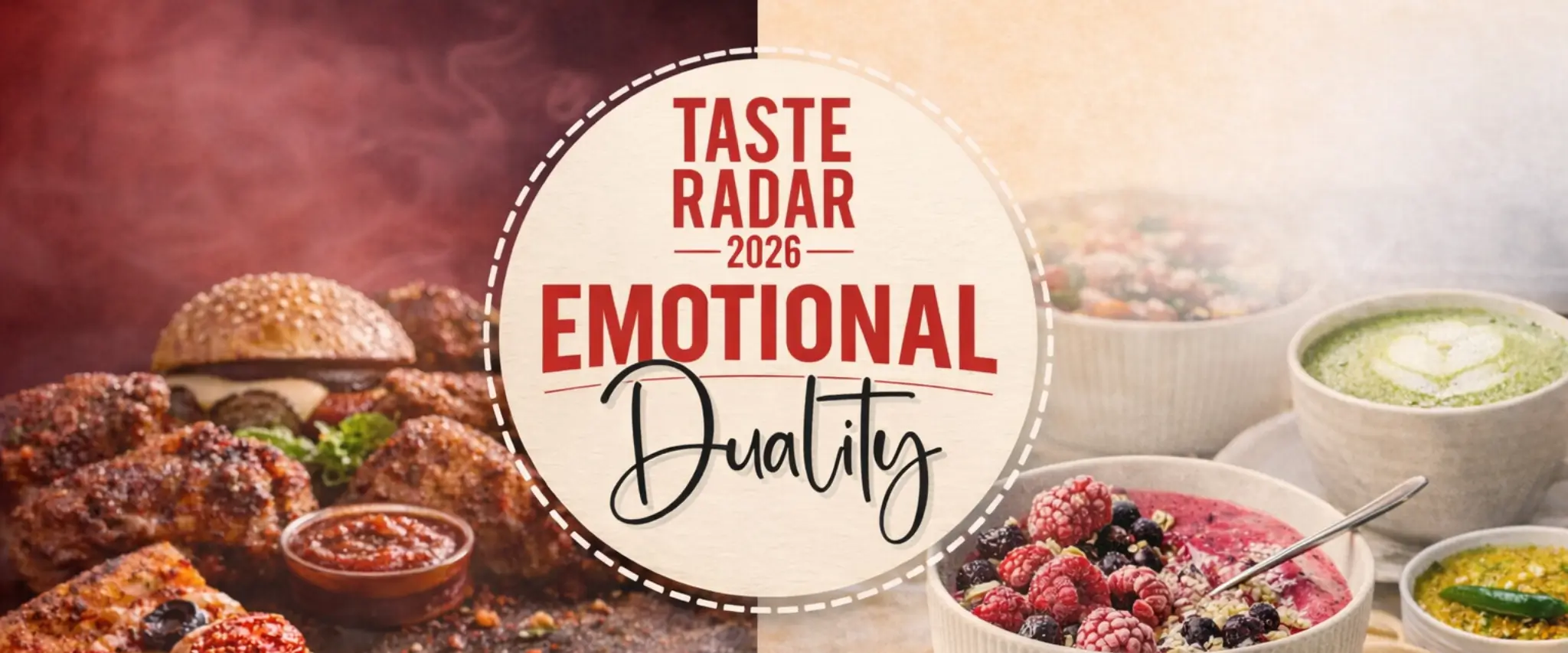
We call this landscape emotional duality.
A] Emotional Duality Explained: How ‘Crave’ and ‘Care’ Now Coexist on the Same Menu
When we talk about ‘Crave’ and ‘Care’ at FSIPL, we’re not talking about nutrition labels or health claims. We’re talking about emotions.
Crave is about intensity, indulgence, reward, and excitement. Care is about comfort, familiarity, balance, and reassurance. What’s changed is that consumers no longer see these as opposites. They expect them to coexist.
You see it everywhere. Heat that’s bold but balanced. Nostalgic flavours delivered with precision rather than excess. Speed that doesn’t feel careless and quality that doesn’t slow things down.
This matters because emotional duality isn’t just a flavour trend; it can also be a menu design constraint. Kitchens today aren’t being asked to be more creative. They’re being asked to deliver contrast without complexity.
At FSIPL, we embrace this duality as part of our innovation and refer to it internally as M.A.Y.A.—Most Advanced Yet Acceptable.
Push innovation too far, and repeat orders suffer. Stay too familiar, and menus lose excitement. The sweet spot sits in between, where something feels new enough to notice but familiar enough to trust again.
In 2026, the winning menus won’t be the boldest or the cleanest. They’ll be the ones that understand how ‘Crave’ and ‘Care’ show up together, operationally and emotionally.
B] The 5 Macro Food and Beverage Shifts Shaping Menus in 2026
Let’s talk about how this duality shows up on menus in practice. At FSIPL, we see it expressed through five macro shifts that are already shaping what scales.
1. Punch – Impact You Can Feel
Visitor attention is scarce, and menus are crowded. In that environment, clarity wins. Punch is about flavour that announces itself immediately with no additional explanation required.
Today’s consumers decide fast. They respond to bold finishes, contrast-led profiles, and first-bite impact. Punch shows up as visual appeal, as add-ons, and as toppings and drizzles that upgrade a familiar base without changing the core. It’s not about being louder; it’s about being instantly resonant.
Further Reading: The Power of Punch: How Instant Flavour Impact Is Shaping Modern Menus in 2026
2. Roots – Regional Truth, Modern Rhythm
Regional flavours aren’t making a comeback. They never left. What’s changed is how they’re being delivered.
Consumers today don’t want nostalgic storytelling without flavour logic. They want regional identity that’s precise, portable, and repeatable. Roots is about systemising authenticity by building dependable regional profiles that travel across formats and price points without losing their character.
Authenticity, in 2026, isn’t about excess. It’s about accuracy.
Further Reading: Roots 2026: How Hyper-Regional DNA Scales Across Modern Restaurant Formats
3. Glow – Small Affordable Luxuries
Premium has been redefined. It’s no longer about portion size or price tags. It’s about texture, aroma, and mouthfeel.
Glow represents the rise of small indulgences from formats that feel elevated without feeling expensive. Think sensory depth instead of novelty. Consumers are willing to pay for richness, creaminess, roast, and finish, even in everyday formats, as long as the reward is obvious.
Further Reading: Glow 2026: Why Small Affordable Luxuries Are the Biggest Menu Opportunity Right Now
4. Flow – When Convenience Becomes Craft
Speed used to signal compromise. Today, it signals competence.
Flow is about fewer steps with no loss of character. Modular systems, multi-use bases, and streamlined assembly allow kitchens to move faster while staying consistent. Convenience has become a quality marker, not a shortcut.
Menus that flow well feel trustworthy. They reassure the consumer that what they ordered will taste the same every time.
Further Reading: Flow 2026: The Modular Kitchen Strategy That Lets You Scale Without Losing Taste
5. Balance – Everyday Cleaner Upgrades
In today’s menus, balance isn’t something consumers look for; it’s something they assume.
Consumers accept better-for-you upgrades when they feel normal by having taste lead and health cues follow quietly. Reduced sugar, cultured tang, lighter bodies, and higher satiety work only when they don’t feel medicinal.
Balance succeeds when it stops feeling like a separate category and becomes the default expectation.
C] The India Adoption Lens: What Scales Fast, What Builds Over Time
Not all trends move at the same speed, especially in India. That’s why Taste Radar looks at adoption through three lenses.
1. Fast Movers
Fast movers are instantly clear. You see them, taste them, and understand them in the first bite or sip. These are safe to scale quickly.
2. Building trends
Building trends need time. They rely on education, repetition, or format evolution. They work best when introduced carefully and tested in controlled environments.
3. Watchlist signals
Watchlist signals are worth observing, not forcing. They may shape future menus, but only when behaviour catches up.
For operators, this lens matters. It helps answer practical questions, such as:
- What can I launch confidently?
- What should I test without pressure?
- And what’s worth simply watching for now?
Clarity at this stage prevents costly missteps later.
D] From Radar to Reality: Ingredient Clusters and Scalable Menu Execution
Here’s the hard truth: ideas are abundant. Execution is not.
Most trend-led launches don’t fail because consumers reject them. They fail because kitchens can’t sustain them due to inconsistency, complexity, or poor fit across formats, delivery, and pricing.
That’s why FSIPL works with ingredient clusters, not trend lists. We consider these clusters to be translation tools. They convert taste signals into usable building blocks that support repeatability, speed, and control.
Instead of chasing individual flavours, clusters allow your teams to work within systems through structured approaches that survive real kitchen conditions. Combined with stable sourcing, R&D translation, and modular, kitchen-ready formats, they drive continuity, flavour integrity, and scalability.
This is where emotional duality becomes executable, not just as an idea, but also as a system.
Conclusion
If there’s one takeaway from Taste Radar 2026, it’s this: the future belongs to brands that can deliver both sides of the mood.
That tension isn’t accidental.
As Tayyaba Shewan, Vice President of R&D at FSIPL, notes:
“There is a quiet paradox that is shaping the food and beverage industry today. Global exposure has never been higher, but cultural pride is rising faster.”
Taste will always come first. But in 2026, taste alone won’t be enough. It’s taste delivered with discipline, clarity, and operational intelligence that will separate what simply launches from what truly lasts.
That’s the difference between spotting trends and turning them into menus that work.