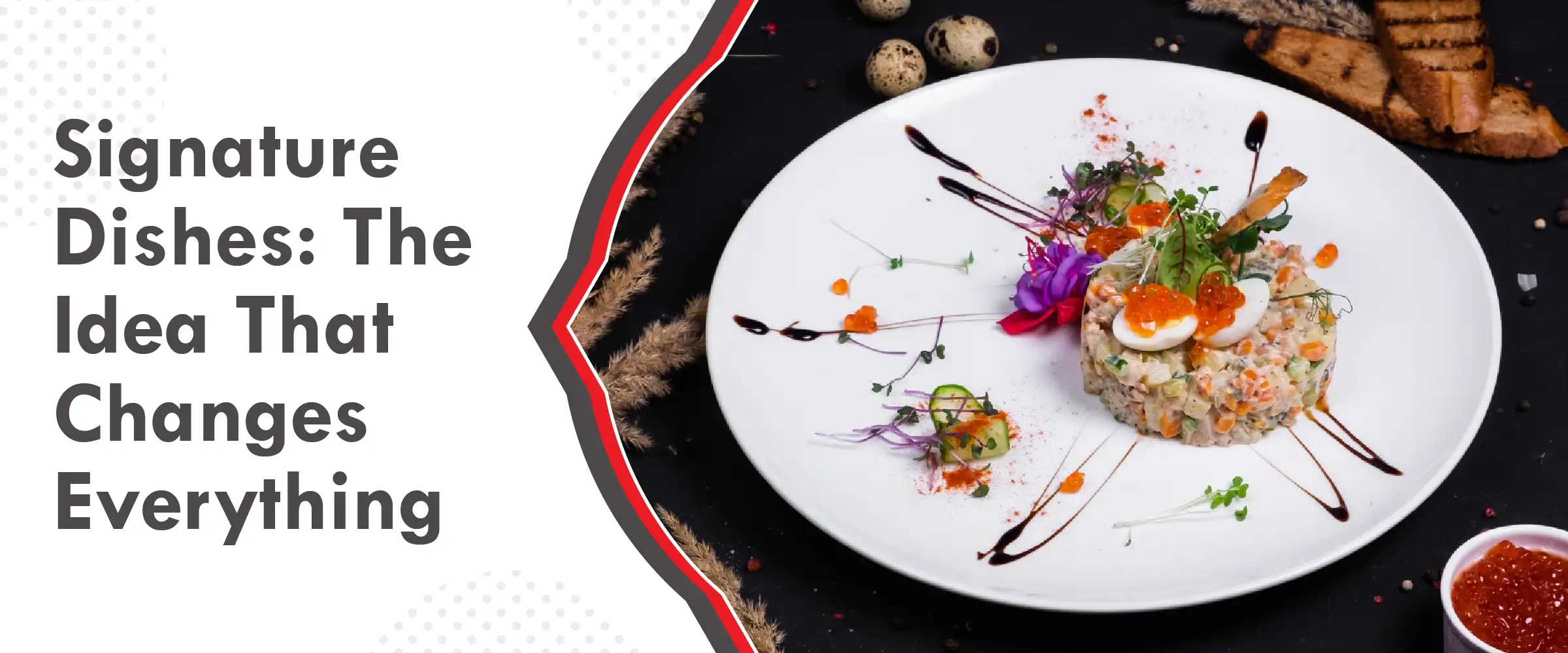
Signature Dishes: The Idea That Changes Everything in F&B
“Luxury is the ability to offer a simple product of exceptional quality. It is not about the gold on the walls; it is about the humility of the ingredients.”
– Alain Ducasse
The Indian foodservice market is a beautiful, chaotic, and overcrowded jungle. New brands pop up on Swiggy and Zomato every hour, screaming for attention with flashy packaging and deep discounts.
However, if you spend enough time in rooms full of chefs and restaurant operators, one truth keeps coming up.
Customers rarely remember your menu. They remember one dish.
Think about how people actually recommend restaurants. No one says, “You should try this place; they have a very balanced menu.” Instead, they say something like, “You have to try their butter chicken,” or “Their dosa is unbelievable.”
Why Every Restaurant Needs a Signature Dish
In a crowded market like India’s, where new cafés, QSR brands, and cloud kitchens appear almost every week, that single memorable plate can define how the entire brand is perceived.
That’s where the idea of a signature dish becomes powerful.
Understanding the meaning of a signature dish is not just about culinary creativity. It’s about strategy.
The most successful restaurants in the world don’t stumble upon these dishes by accident; they design them carefully so that one item becomes the emotional and commercial anchor of the brand.
A] What Makes a Dish “Signature” in Modern Foodservice?
Let me ask you a question that often sparks debate in industry circles: what is a signature dish?
Many people assume it simply means the chef’s personal favourite or the most creative item on the menu. But if you talk to operators who run multi-outlet brands, they’ll tell you something different.
In a modern, scalable foodservice environment, a dish only earns its “Signature” stripes if it survives a four-way collision between art and commerce.
- The Sensory Hook (Taste and Memorability): It must have a “craveability” factor. This is often a specific flavour profile, such as a hit of umami, a certain level of heat, or a texture that is difficult to replicate at home.
- The “Rush Hour” Test (Consistency at Scale): If your head chef can make it, but your line cook on a double shift can’t, it’s not a signature dish. It’s a risk.
- The Margin Protector (Operational Feasibility): Can we source the ingredients year-round without a 300% price fluctuation? Does it use existing equipment, or am I buying a new combi-oven just for one menu item?
- The Brand Mirror (Storytelling): Does the dish explain who you are? A signature menu’s meaning is effectively your brand’s elevator pitch on a plate.
If you can’t tick all four boxes, you don’t have a signature; you just have a popular special.
B] Why Signature Dishes Are Important for Restaurant Growth
Let’s talk numbers, because for stakeholders, that’s their shared language. We often see operators terrified of “menu shrinkage”, fearing that fewer items mean fewer customers. The data tells a different story.
1. Brand Recall and the “Instagram Tax”: In 2026, your signature food meaning is defined by social media discovery. When a diner scrolls through Instagram, they aren’t looking for a “good Italian restaurant”. They are looking for “that specific truffle pasta with the cheese wheel”. According to a recent consumer behaviour study, nearly 73% of Gen Z and millennial diners have visited a restaurant specifically for a “hero” item they saw online in a review or post.
2. Reducing the “Paradox of Choice”: Decision fatigue is the silent killer of table turnover. When a guest opens a 12-page menu, their brain stalls. A prominent signature dish acts as a psychological shortcut. It reduces ordering time, which in turn increases table turns. Furthermore, what is a signature dish if not a predictability engine? It drives repeat visits because the customer knows exactly what they’re getting. High predictability equals high reorder rates.
3. The FSIPL Operational Edge: This is where we get into the “boring” stuff that actually makes the money: back-of-house efficiency. Focusing on a hero dish allows for:
- SKU Rationalisation: Instead of stocking 500 different ingredients, you master 50.
- Lower Wastage: High-volume “hero” items ensure that fresh produce moves through the kitchen before it even thinks about wilting.
- Procurement Power: When you partner with a leading HoReCa company in India, you get the advantage of standardised marinades, gravies, and seasonings. This allows you to ensure that your signature dish tastes the same in your Delhi outlet as it does in the Chennai outlet.
C] Real-World Examples: The Legends of the Game
To understand signature dish examples, we have to look at the brands that turned a recipe into a legacy.
1. Rameshwaram Café – Podi Masala Dosa
Few recent restaurant success stories in India have been as explosive as Rameshwaram Café.
The Bengaluru-based brand built massive buzz around its podi masala dosa, which is their signature dish drenched in ghee and layered with bold flavour. Customers didn’t just visit the café out of curiosity. They went there specifically for that dosa.
Social media accelerated the momentum. Suddenly, every food influencer was in the kitchen filming the prep, and diners were flooding feeds with reels. Before the month was out, that one dish didn’t just represent the brand; it was the brand.
Within a short time, queues outside the outlets became the norm, and the business expanded rapidly, even opening internationally in Dubai and recently in Mumbai.
2. Kwality – Pindi Chana Bhatura
On the other end of the spectrum sits a legacy brand that has quietly demonstrated the same principle for decades. Kwality in Delhi became famous for its Pindi chana bhatura. Generations of diners associate the restaurant with that one dish.
As the menu matured, the brand didn’t lose its way. The hero item stayed at the centre of the bullseye, as it was the ‘hook’ that got them through the door. The rest of the expanded menu did the heavy lifting of driving up the average order value.
This is the essence of the signature menu meaning: a dish that becomes the restaurant’s shorthand identity.
D] From Idea to Icon: The Engineering Process Behind a Successful Signature Dish
You don’t “find” a signature dish in a cookbook. You build it.
Step 1: Data-Driven Development: Start with the customer, not the kitchen. Use your POS data. We see it all the time when brands try to force a “signature” that nobody is buying. Even “familiar with a twist” items, like premium chicken sandwiches, can command up to 36% of total order volume in the QSR segment.
Step 2: Solving the “Consistency Gap”: The biggest tragedy in F&B is the “founder’s trap”, where the food is amazing when the owner is watching and mediocre when they aren’t. To prevent this, you must de-skill the complexity. This is the core of our philosophy at FSIPL. Whether it’s a specific seasoning or a standardised beverage base, the goal is to make the “best version” of the dish the “easiest version” to make. This is how you achieve best signature dish status across multiple geographies.
Step 3: The Pilot Phase: Never go “all-in” on a signature without a feedback loop. Run a “Limited Time Offer” (LTO). If the dish doesn’t hit a 20% reorder rate during the pilot, it’s back to the drawing board.
E] The Hidden Challenges (and the FSIPL POV)
Scaling a signature dish is where most brands break. You’ll hit three walls:
- The Talent Gap: As you open outlet #5, you realise you can’t find 5 more “master chefs”.
- Ingredient Volatility: The price of tomatoes or onions spikes, and suddenly your margins on your hero dish vanish.
- The Quality Drift: Over time, kitchen staff take shortcuts.
This is where we step in as your strategic HoReCa solutions partner. We don’t just sell ingredients; we sell “standardisation-in-a-box.” By using our pre-standardised formats, think high-performance gravy bases, precisely balanced seasonings, and scalable beverage solutions for HoReCa; you remove the human error.
You also protect the meaning of your signature menu from the chaos of the kitchen.
Conclusion
At the end of the night, when the shutters go down, your signature dish is more than just food. It’s a brand asset.
It’s your marketing strategy, your operational blueprint, and your growth engine all rolled into one. It is the “simple product of exceptional quality” that defines your legacy.
For those of you looking to build something that lasts, something that scales without losing its soul, remember that you don’t have to do it alone. The right partner turns a great recipe into a great business.
FAQs
Think of a signature dish as your brand’s culinary DNA. It is a specific creation that embodies your brand’s identity, flavour profile, and quality standards. In the eyes of your guest, it’s the “must-order” item, one that makes a trip to your outlet non-negotiable. From an operational standpoint, it’s a high-volume, high-consistency hero that anchors your P&L.
In a sea of “me-too” restaurants, a signature dish beyond just being a “famous dish” serves three critical business functions:
- It drives organic social media discovery (your lowest-cost marketing)
- It reduces guest decision fatigue (speeding up table turns)
- It allows for hyper-efficient procurement
Without a signature, you’re just selling food; with one, you’re selling an experience that people will travel for.
You don’t just cook it; you engineer it. Start with data. What are people already craving? Then, add a “twist” that is uniquely yours. If the dish requires a Michelin-starred chef to be present every day, it won’t survive a ten-outlet expansion. This is where partnering with an expert like FSIPL becomes a game-changer. We help you translate that “creative spark” into standardised bases, marinades, and seasonings so that “the best version” is the only version served.
Absolutely. In fact, some of the highest-margin signature items in the industry are liquids. Whether it’s a proprietary spice-blend chai or a craft-syrup mocktail, a signature food meaning extends to anything a customer identifies solely with your brand. The key is repeatability. If you can standardise a unique beverage profile using consistent syrups and premixes, you’ve created a high-margin “hook” that requires zero kitchen prep time.
There is nothing more damaging to a brand than a customer coming in for “that famous dish” and getting a mediocre version because the kitchen was busy or the raw ingredients changed. You mitigate this risk through standardisation. By using centralised sourcing and pre-standardised formats, like the ones we develop at FSIPL, you ensure that your brand promise remains intact, whether you’re serving fifty guests or five thousand.