The Power of Punch: How Instant Flavour Impact Is Shaping Modern Menus in 2026
If you step back and observe how consumers interact with food today, one thing becomes clear very quickly: they decide fast.
Not after reading the menu, and not after finishing the dish, but in the first few seconds. Sometimes even before the first bite. In a world shaped by scrolling, visual menus, and delivery-first formats, a dish has a narrow window to register, signal what it is, and justify its price.
This is where flavour is shifting.
We’re moving away from slow-build complexity toward something far more immediate, Punch. Flavour that doesn’t need decoding and doesn’t rely on explanation, because it declares itself upfront.
This isn’t just a stylistic change. It’s structural. As India’s QSR market expands and menus become denser, competition is no longer about variety alone. It’s about clarity, and in that environment, subtlety struggles.
Impact, in 2026, has to be obvious. It has to land early, and more importantly, it has to be remembered.
A] The Psychology of “Crave”: Why We Want Impact
Punch sits at the heart of ‘Crave’ not as excess, but as reward.
Consumers today are not just responding to taste; they are responding to experience. Texture, sound, temperature, and visual cues all come together in a single moment, and that first bite often carries more weight than the rest of the dish.
Crunch feels fresher. Heat feels more alive. Contrast feels more complete. These are not incidental reactions; they reflect how the brain processes flavour and assigns value.
When the “kick” is immediately identifiable, for example from a sweet heat glaze, a sharp tang, or a smoky finish, the product feels more satisfying. Not because it is more complex, but because it is more legible. Clarity, in that sense, becomes the reward.
This is where our M.A.Y.A. (most advanced yet acceptable) principle holds true. Push too far into novelty and repeatability drops; stay too safe and attention fades. Punch works in that narrow band where something feels just new enough to excite but familiar enough to trust.
That is where ‘Crave’ turns into a habit.
B] The Science of Contrast: Building the Layers
Punch is often mistaken for intensity, but that is only part of the story. What actually makes flavour memorable is contrast.
It is the movement between notes, the tension between opposing elements, and the way one sensation sharpens another. The combinations that work today follow a clear pattern.
- Sweet and heat: This creates a layered experience where sugar softens aggression while spice sharpens sweetness.
- Tang and smoke: This combination brings together brightness and depth, allowing both to stand out more clearly.
- Crisp and creamy: This combination uses texture as a carrier of flavour, making the experience feel richer and more complete.
But contrast does not operate in isolation. It is supported by specific flavour carriers that make the experience more immediate and more expressive, such as:
- Chilli-crunch textures: They add both heat and texture, turning flavour into something you can hear and feel.
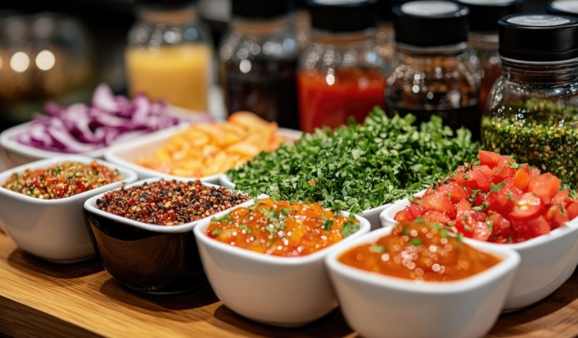
- Flavoured oils: They deliver intensity with minimal volume, allowing aroma and spice to spread evenly across the dish.
- Sweet-heat glazes: They create a glossy, cohesive layer that binds contrasting notes together while enhancing visual appeal.
- Tang boosters: Often driven by citrus or fermented acidity, they lift heavier profiles and sharpen the overall experience.
- Umami lifts: They add depth and roundness, ensuring that bold flavours do not feel flat or one-dimensional.
- Smoke and charred notes: They introduce a sense of familiarity and richness, especially in grilled or roasted formats.
- Pepper heat with citrus lift: They offer a more nuanced form of intensity, where heat builds gradually and is balanced by brightness.
Finally, crunchy finishes and aromatic notes complete the experience. They extend flavour beyond taste, engaging smell and texture to create a fuller, more memorable impact.
These elements work together as a system. Punch is not about any single flavour; it is about how multiple signals come together, quickly and clearly, in the first bite.
C] The “Impact Stack”: Navigating the Ingredient Cluster Heatmap
To make Punch repeatable, flavour has to be structured. At FSIPL, we look at this through what we call the ‘Impact Stack’, which is a layered approach to building flavour that is both scalable and recognisable.
Heatmap
| Category | Ingredients | Application Logic |
|---|---|---|
| Category: Mainstream | Ingredients: Schezwan, Peri-Peri, Sweet Chilli, Gochujang, Smoky Chilli, Tamarind-Chilli, Green Chutney | Application Logic: These provide the foundation. Use them for reliable, high-volume heat. |
| Category: The "Next" Wave | Ingredients: Peanut Chilli Oil, Raw Mango Chilli, Hot Honey, Kimchi, Achari, Curry Leaf, Habanero | Application Logic: This is the competitive edge. These ingredients are "scaling now". |
| Category: The Watchlist | Ingredients: Black Garlic, Koji Chilli, Cocoa-Chilli, Regional Indian Chilli Oils, Shito Pepper | Application Logic: Future-proofing. These represent the next frontier of sophisticated, layered punch. |
Format: Sauces, glazes, crunchy toppers, flavoured oils and seasoning blends
At the base are the mainstream anchors: Schezwan, Peri-Peri, and Gochujang, among others. These are not just flavours but signals that are instantly recognisable, widely accepted, and easy to deploy across formats.
Then comes the next wave, where differentiation begins to take shape. Hot honey, peanut chilli oil, and raw mango chilli, among others, are gaining traction because they introduce contrast without confusion. They feel new but are still intuitive enough to drive repeat behaviour.
The data supports this direction. Hot honey, for instance, has seen a sharp rise in global menu presence over the past few years, reflecting how quickly contrast-led formats can scale when they are clearly understood.
Beyond that sits the watchlist, which includes black garlic, koji chilli, and cocoa-chilli, among others. These ingredients are still emerging, but they point toward a deeper evolution of Punch, where fermentation, umami, and layered sweetness begin to play a larger role.
The goal is not to use everything at once. It is to understand where each layer sits and how it fits within the menu.
Because Punch, when overdone, becomes noise. When structured, it becomes identity.
D] Operationalising Punch: Speed vs. Character
This is where most ideas begin to break; not at the level of flavour, but at the level of execution.
There is a common assumption that bold flavour requires more effort. In reality, the more complex the process, the harder it becomes to scale consistently.
The systems that work today are built on simplicity. A stable base combined with interchangeable Punch elements allows kitchens to create variety without increasing operational burden.
This approach is already visible across QSRs in India, where standardised inputs and premix systems are improving throughput while maintaining consistency. Punch fits naturally into this model because it relies on layering rather than reinvention.
A single preparation can support multiple outcomes simply by changing the finishing elements. This makes menus feel dynamic while keeping operations controlled.
Consistency then becomes the real differentiator. Delivering the same taste every time, across locations and formats, is what builds trust, and trust is what drives repeat orders.
Conclusion: From Intent to Action
Punch is not a trend. It is a response to crowded menus, faster decisions, and higher expectations.
It takes familiar formats and makes them worth noticing again, but it only works when it is executed with discipline.
Make it intense, but clean. Make it visible, but not overwhelming.
Because in 2026, Punch is not about being louder. It is about making flavour impossible to ignore.
FAQs
The “Base + Boost” model allows a kitchen to use one high-quality, multi-use base across several dishes while changing the final experience through unique “Punch” toppers or drizzles. This modular approach enables brands to launch multiple seasonal or trending items without increasing core inventory or complicating the assembly line.
In an attention-scarce market, “Punch” is your instant flavour clarity. It provides that hit of high-impact seasoning that announces itself from the very first bite. These aren’t just “upgrades”; they are primary value drivers that spike consumer interest and practically beg for a menu add-on. When the flavour is “loud”, your brand doesn’t just sit on the plate; it starts a conversation.
The veteran move is to keep your base rock-solid and stable, then introduce “Punch” through high-impact finishing elements like seasoned oils or dry-rub blends. This allows your menu to stay dynamic and bold without adding a single minute to your line’s ticket times.
“Punch” isn’t a trend; it’s a structural response to a noisier, more competitive market where guests demand immediate flavour gratification. The need for clarity and “immediacy” on the palate is only going to intensify as consumer expectations evolve. If you aren’t building “Punch” into your R&D today, you’re essentially whispering in a room full of people who are shouting.
Winning brands use modular “Base + Boost” systems, combining one solid multi-use base with various finisher packs to change the guest experience without complicating the workflow. This approach ensures reliable delivery of the same taste and texture every single time, turning speed into a signal of competence rather than compromise.