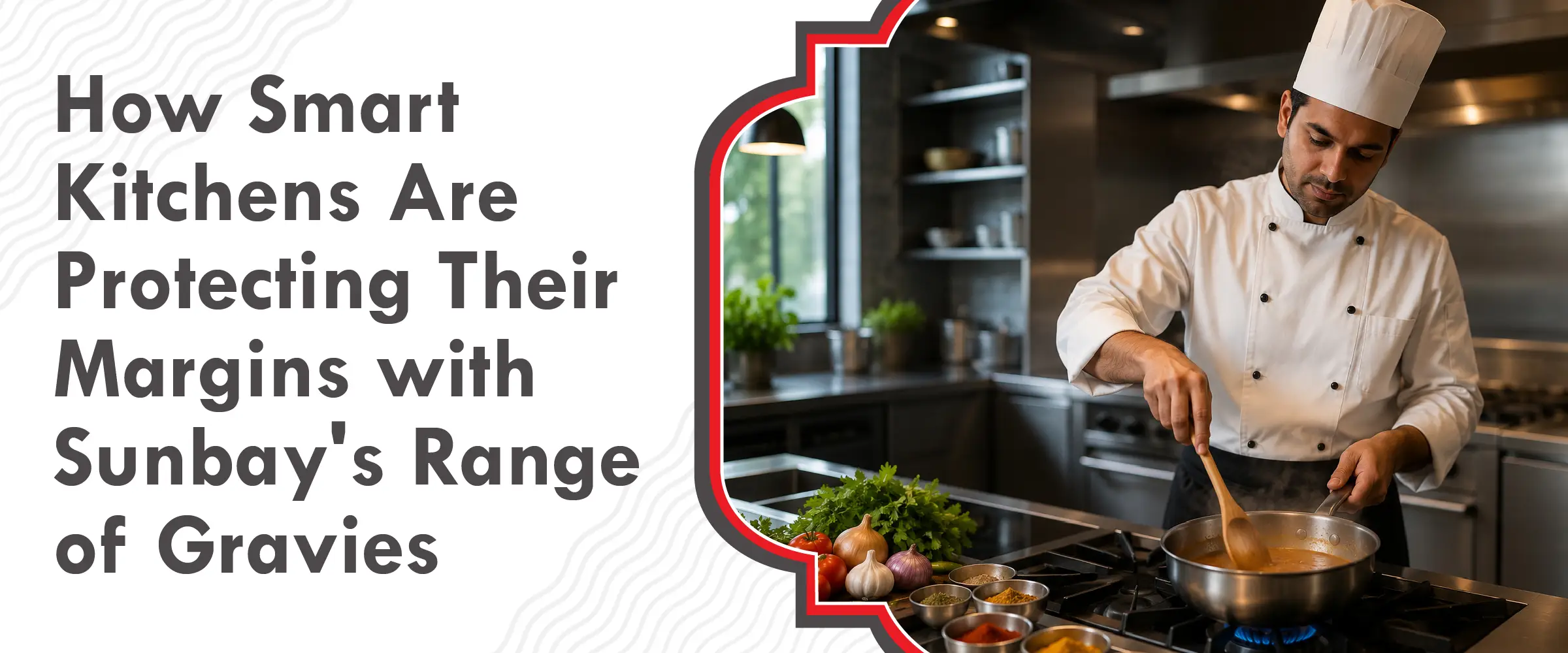
How Smart Kitchens Are Protecting Their Margins with Sunbay's Range of Gravies
If you are currently staring at your P&L and wondering why your prime cost is bleeding despite your ingredient contracts staying relatively stable, you are looking at the wrong line item. You need to look at your utility bill. Specifically, you need to look at your LPG consumption. We are operating in an era where the flame is often as expensive as the protein. Every single minute that a burner stays on in your kitchen is a direct and aggressive hit to your bottom line.
Rethinking Flame Time as a Variable Cost
Most operators spend their entire day obsessing over yield, portion control, and waste bins, yet they ignore the fact that a massive pot of Dal Makhani simmering for ninety minutes is a literal money pit.
You are not just cooking food in that scenario. You are burning fuel that is currently priced at a premium. When you calculate the true landed cost of a dish, you have to include the flame time as a primary variable. If your kitchen is still running on 100 percent old-school scratch methods during this gas price hike, your margins are not just thin. They are evaporating into the exhaust hood.
See how it works in practice: Watch our recipe reel on Dal Makhani using Sunbay’s ready-to-use base.
From Overhead to EBITDA Driver
The reality of the modern Indian kitchen is that heat is a heavy expense. We have moved past the days when gas was a negligible overhead. Today, it is a variable cost that can make or break your monthly EBITDA. To understand the gravity of the situation, look at how the minutes add up across your most popular items.
| Dish | Avg. Flame Time (From Scratch) | LPG Cost Per Batch |
|---|---|---|
| Dish: Dal Makhani | Avg. Flame Time (From Scratch): 90 min | LPG Cost Per Batch: ₹185 |
| Dish: Butter Chicken | Avg. Flame Time (From Scratch): 75 min | LPG Cost Per Batch: ₹150 |
| Dish: Korma | Avg. Flame Time (From Scratch): 60 min | LPG Cost Per Batch: ₹120 |
| Dish: Onion Tomato Base | Avg. Flame Time (From Scratch): 45 min | LPG Cost Per Batch: ₹90 |
Disclaimer: The LPG cost figures above are based on estimated consumption for a standard high-pressure commercial burner at current market rates. Actual costs may vary based on burner efficiency, batch size, and local utility pricing. These figures serve as a benchmark for comparing relative energy expenditure across different preparation methods.
A] What "Protecting Margins" Actually Means in a Crisis Kitchen
In our industry, everyone loves to throw around the phrase “cut costs”. But as any veteran operator knows, you cannot simply cut your way to a healthy bottom line. If you cut the quality of your dairy, the guests notice. If you cut your staffing levels, your service speed falls apart and your online ratings tank. If you cut portion sizes, you lose the value proposition that keeps regulars coming back.
The New Variable: Heat as an Asset
Protecting your margins in a high inflation environment means maintaining your cover count and your plate quality without letting the overhead swallow the profit whole. The smartest operators are not just cooking less food. They are simply refusing to waste heat. They are looking at the kitchen as a production line where time on flame is the most expensive variable in the entire building.
Scaling Authenticity Without the Overhead
Margin protection is about being agile enough to bypass the most expensive and time-consuming parts of the prep cycle while keeping the soul of the dish intact. It is about realising that your chefs should be focused on final seasoning and presentation rather than standing over a boiling pot for three hours just to get a base consistency right. In a crisis, the winner is the one who produces the same high-quality output with half the energy input.
B] How Sunbay’s Gravy Range Changes the Equation
This is where we move from the high-level theory of the P&L down to the actual grit of the line. The Sunbay range is not just a shortcut or a convenience product. It is a thermal efficiency tool designed for high-volume environments. When you integrate our Makhani or Onion Tomato base into your workflow, you are essentially buying back hours of gas consumption that would otherwise be wasted.
The Case Study: Paneer Lababdar
Let’s consider one of the most popular menu items across Indian restaurants: Paneer Lababdar. In a traditional scratch kitchen, you are roasting, pureeing, straining, and then reducing that sauce for over an hour to get the right mouthfeel. With Sunbay’s Yellow Gravy base, that ninety-minute LPG burn drops to less than fifteen minutes. You are achieving the exact same silkiness and the same balanced tang that your regulars expect, but you are doing it in a fraction of the time.
See the transformation for yourself: Watch our Paneer Lababdar recipe video.
Financial Predictability in a Volatile Market
The range is built to cover your high-volume bases. You have the velvety Korma, the incredibly versatile onion-tomato base, and the heavy-hitting Dal Makhani. Because these products are shelf-stable and mathematically consistent, your portion cost stays exactly the same even when gas prices are swinging wildly in the external market.
You are locking in your costs in a world where almost nothing else is locked in. This allows for a level of financial predictability that scratch cooking simply cannot offer in the current climate.
Explore Sunbay’s full range of ready-to-use gravy bases and find the right fit for your kitchen.
C] What Smart Kitchens Are Actually Doing Differently To Combat The LPG Crisis
To really understand the impact, you have to visualise two different kitchens during a Friday night dinner rush.
Kitchen A: The High-Burner Chaos
In Kitchen A, the traditional scratch kitchen, the atmosphere is borderline chaotic. They have four or five burners occupied just by base gravies that are simmering down. The ambient heat in the kitchen is unbearable, which means the air conditioning and exhaust fans are working at absolute maximum capacity. The prep team had to start their shift between 3 PM and 5 PM just to be ready for the 7:00 PM rush. Every time a new order comes in, the chef has to juggle limited burner space because the “long haul” pots are taking up all the real estate.
Kitchen B: The On-Demand System
In Kitchen B, the Sunbay kitchen, the burners stay off until the moment the order hits the KOT (Kitchen Order Ticket). When an order for a Korma or a Paneer Tikka Masala comes in, the chef utilises the Sunbay base, finishes it with their signature touch of cream or spice, and has it out in under ten minutes. The kitchen stays significantly cooler, which reduces staff fatigue and lowers the electricity bill for cooling.
The “Bottom Line” Comparison
The gas meter in Kitchen B is not spinning like a top all day long. It only moves when food is actually being finished for a guest. Kitchen B is doing the exact same number of covers as Kitchen A, but their operational reality is vastly different:
- Utility Bills: 40% lower in Kitchen B.
- Labour Efficiency: 30% higher in Kitchen B.
The Verdict: This is the fundamental difference between an operator who is simply working hard and one who is working with a sophisticated, systematic approach to heat and time.
D] The Margin Maths: From-Scratch vs. Ready-Base
Stop estimating. Run the actual numbers for your kitchen.
Here is a conservative per-portion comparison across a standard 40-cover service:
| Cost Component | From Scratch (Per Portion) | Sunbay (Per Portion) |
|---|---|---|
| Cost Component: Raw ingredients | From Scratch (Per Portion): ₹38 | Sunbay (Per Portion): ₹42 |
| Cost Component: LPG cost allocated | From Scratch (Per Portion): ₹22 | Sunbay (Per Portion): ₹4 |
| Cost Component: Labour time allocated | From Scratch (Per Portion): ₹18 | Sunbay (Per Portion): ₹7 |
| Cost Component: Total cost per portion | From Scratch (Per Portion): ₹78 | Sunbay (Per Portion): ₹53 |
This equates to:
- A ₹25 saving per portion.
- Across 40 covers, per service, that is ₹1,000 back in your pocket.
- Per month, across 25 service days, that is ₹25,000 in recovered margin. From one operational switch.
The red flag to check tomorrow morning: pull your last three monthly LPG invoices and divide total gas spend by total covers served. If your gas cost per cover has increased more than 30% in the last six months and your menu prices have not moved, you have a margin erosion problem that is only going to compound.
*Figures provided are based on standard commercial kitchen benchmarks for a north Indian menu in a 40-cover restaurant. Ingredient costs are indicative averages. The Sunbay product cost per portion is calculated at standard HORECA pricing. Actual figures will vary by location, supplier, and operational setup.
Conclusion
The LPG crisis will eventually stabilise. Input costs will not.
The volatility you are managing today, whether it is gas, freight, or raw material pricing, is the new normal for Indian foodservice. The operators who come out ahead are not the ones who waited for prices to drop. They are the ones who restructured their kitchens while everyone else was absorbing the hit.
Sunbay is not a crisis workaround. It is a permanent margin-protection tool that FSIPL, as a leading food products supplier in India, has built for commercial kitchens that cannot afford to leave ₹25 per portion on the table for every service.
The question is not whether you can afford to make the switch. It is whether you can afford not to.